THE MARCH ON CYBERSTAN: HELLDIVERS 2 IN RETROSPECT
Helldivers 2: Machinery of Oppression
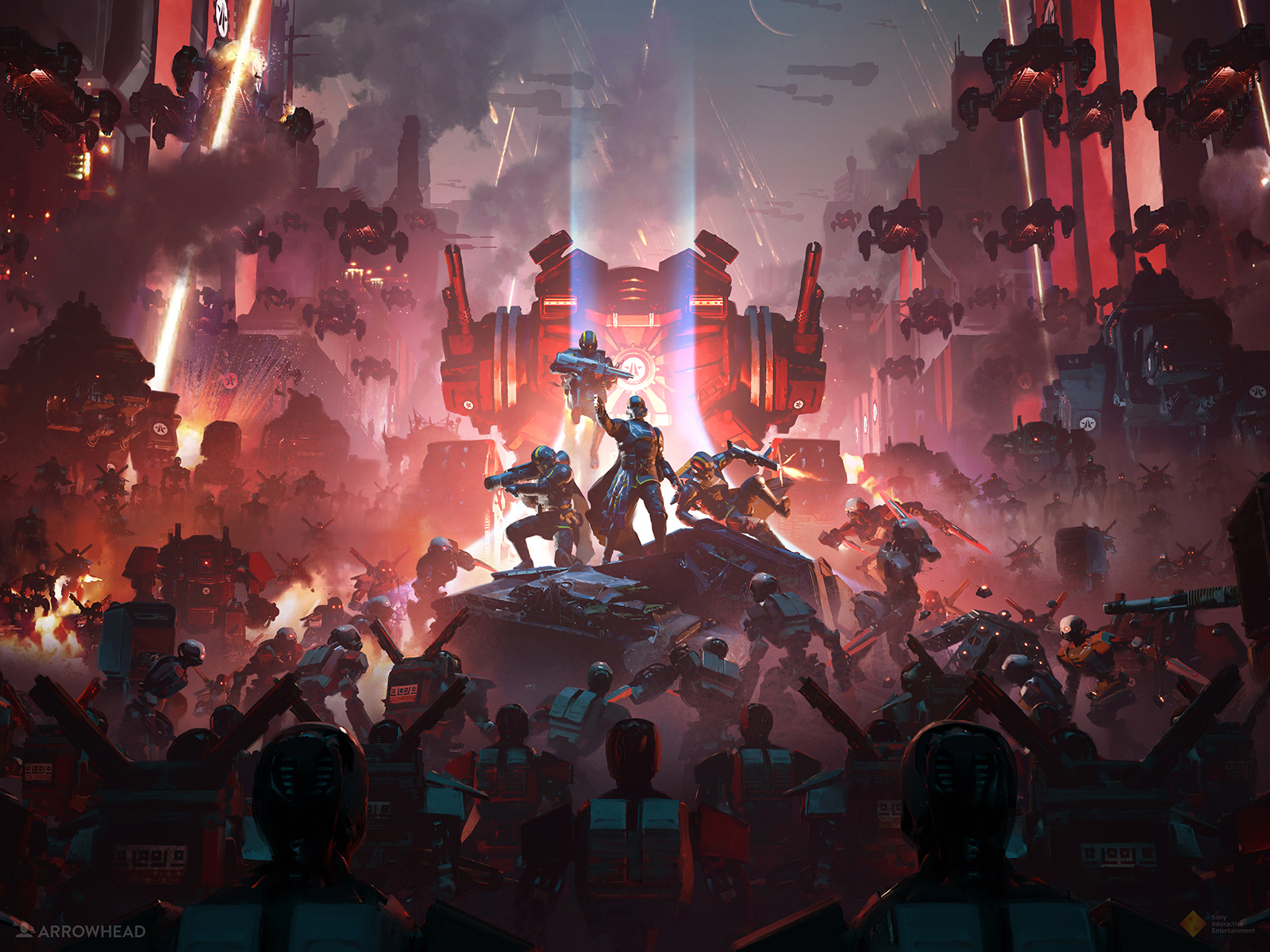
Exactly two years ago, Arrowhead Studios released a sequel to Helldivers that took the gaming world by storm. Having had it’s ups and downs throughout it’s lifecycle, namely due to the PSN restriction debacle and periods without much new content release, the game has once again surged in popularity with their newest update and additions to the game. Centered on newly returned faction from the first game, The Cyborg Secessionists, this update is shaping up to be the biggest biggest resurgence of players since launch, surpassing the three previous major updates to the game. This newfound momentum prompted a step back. Rather than reviewing Helldivers 2 as a launch phenomenon, this feels like the right time to reevaluate it as a living system, with two years of updates, controversy, balance changes and community driven narrative. This is a retroactive review of Helldivers 2, two years on. Assessing how it plays today and what it has become since launch.
Narrative - 16
Helldivers 2 frames players as elite soldiers defending “Super Earth” against “evil” alien threats in the name of “Managed Democracy.” The premise is intentionally exaggerated: humanity spreads freedom across the galaxy through overwhelming militaristic force, battling factions such as the Terminids, Automatons, Illuminate, and now the returning Cyborg Secessionists. At launch, the narrative functioned more as framing device than a classic story. It provided context and tone but little in the way of deeper development or plot progression; which, for a cooperative multiplayer shooter, was perfectly acceptable. The game was never trying to be a narrative campaign; it was trying to create a setting for systemic and cinematic chaos.
Where Helldivers 2 compensated was through political satire. The propaganda broadcasts, mission briefings, and celebratory tone of authoritarian patriotism gave the game a distinct voice. Over the past two years, that voice has unmistakebly sharpened. The ongoing Galactic War, shifting frontlines, faction returns, and developer-driven “major orders” have evolved the narrative into something more dynamic, interactive and communal. Community participation has directly influenced which planets fall or are liberated, blurring the line between scripted storytelling and player-driven history. As the war has escalated, so too has the satire. Becoming more pointed, more self-aware, and more integrated into the live-service structure. What began as a thin narrative structure has grown into a living political theatre shaped as much by player agency as by developer intent.
Visuals & music - 19
If the narrative provides the frame, the audiovisual layer delivers the real spectacle. The score in Helldivers 2 has remained largely consistent since launch: bold, triumphant, and unmistakably patriotic. It may not be particularly experimental or varied, but that restraint works in its favor. The music leans heavily into glorious “freedom” anthems. Orchestral swells, epic motifs and militaristic tones that amplify the game’s satirical framing of Super Earth’s crusade against the alien threats. Combined with well executed audio design, from the mechanical punch of firearms to the thunder of orbital strikes and the hum of bombers zooming past, the soundscape reinforces both intensity, chaos and irony. Every explosion sounds weighty, every stratagem deployment feels impactful, and the battlefield is sonically alive and responsive to the player’s every move.
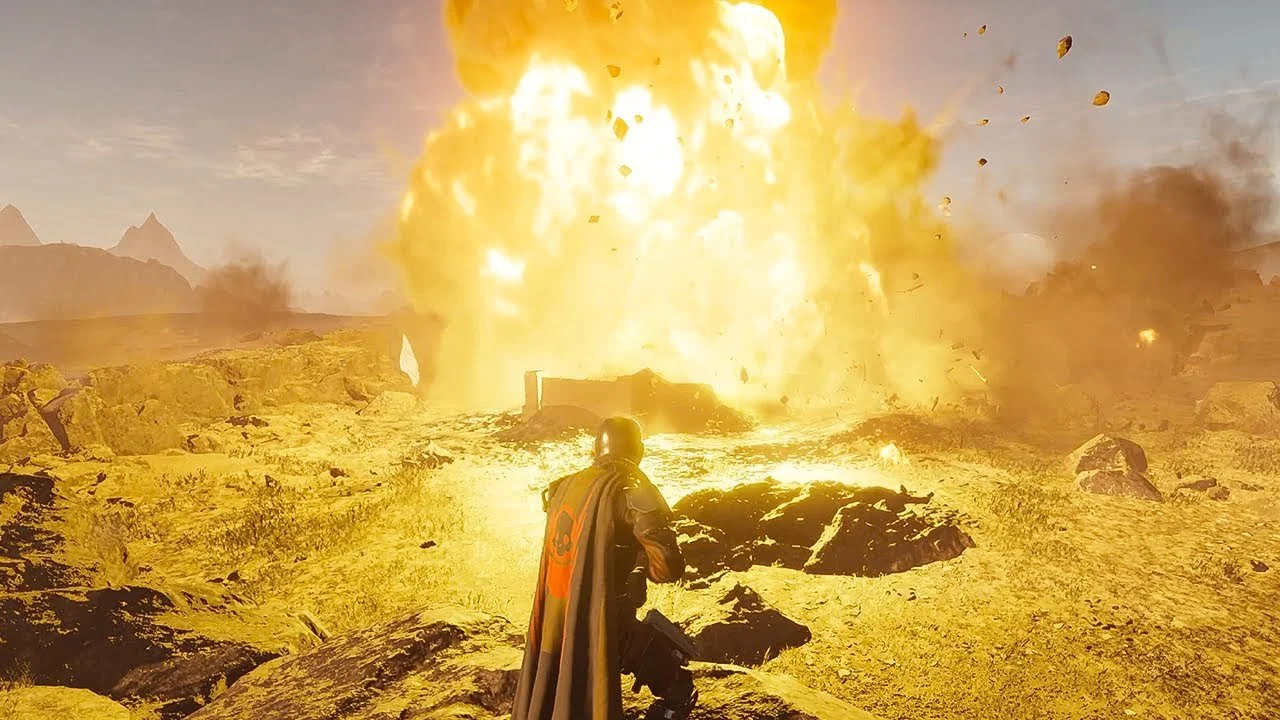
Visually, however, is where the game truly excels amongst its peers. Helldivers 2 consistently delivers mind-numbing cinematic spectacle, with each mission unfolding like a playable Star Wars or Starship Troopers-inspired set piece. From dynamic lighting, dense particle effects, and large-scale enemy swarms creating moments that feel chaotic yet real, to explosions that illuminate night skies, laser fire cutting through fog and dust, and planetary environments that look both hostile and beautiful; It wouldn’t be far fetched to claim that the visuals alone hold the player’s suspension of disbelief. Furthermore, since launch, character armor sets and cosmetic designs have grown more varied, offering stronger visual identity across squads while maintaining the game’s militaristic aesthetic. The result is a graphical presentation that impressively enhances the game’s tone of exaggerated cinematic warfare, making every deployment feel like a dramatic chapter in an ongoing hollywood space opera.
Mechanics - 17
Helldivers 2 is at its core built to generate pressure. As a cooperative “extraction” shooter, its foundational mechanics already lean toward instability: limited reinforcements, stamina-bound movement, escalating enemy patrols, timed objectives, and the constant threat of being overrun by ever increasing waves of enemies. Friendly fire is permanently enabled, meaning every firefight carries the risk of self-inflicted disaster. It is fairly common to be sent ragdolling into the air after being caught in a fellow helldiver’s 500kg bombing run. Reloads are very un-forgiving, positioning is fragile, and small mistakes compound very quickly. These design quirks are far from accidental, they form a deliberate tension and stress architecture. The game rarely allows players to feel “fully” in control; instead, it sustains am increasing baseline of stress that keeps every mission volatile and chaotic.
But these are fairly common mechanics in the genre. The unique mechanics that sets apart Helldivers 2 from its peers, are what truly intensify the aforementioned volatility. First, stratagems require manual input sequences under pressure, forcing players to momentarily divert attention from combat to execute support calls. Punching in a complex sequence of buttons while enemies are unforgivingly closing in is truly one of the most fun but stress inducing mechanics to exist. Second, support weapons are powerful but situational, demanding good coordination rather than individual skill if the goal is to leverage their full potential. Player physics amplify unpredictability: ragdoll knockbacks, explosive shockwaves, and environmental hazards disrupt stability and punish player complacency. Latsly, Enemy design reinforces this instability, with swarm behavior, armored threats, and unpredictable spawn escalation that constantly shift battlefield tempo. Taken together, these systems suggest a conscious design philosophy. Helldivers 2 is engineered to keep players slightly overwhelmed. Therefore, the stress is not incidental it is the intended emotional texture of play. And when that tension scales outward into the shared Galactic War map and community-driven objectives, the pressure no longer belongs only to the squad of friends… It belongs to the entire community.
Procedural Rhetoric - 20
Of course this wouldn’t be a PROC3SS review without examining the game through its procedural rhetoric. Our three-strata model moves from what a game states explicitly, to what it models through rules and constraints, and finally to how it shapes the player through agency, rewards, and feedback loops. Because in interactive media, meaning is enacted, not written.
The most distinctive rhetorical layer of Helldivers 2 lies in the Galactic War map. Individual agency on the battlefield is intense and immediate, but at the macro level it becomes diffused into collective participation. Every completed mission contributes to planetary liberation percentages, feeding into a persistent, community-driven war effort. It is, for better or worse, a step down from direct player agency. No single squad can determine the fate of a planet, yet it remains interactive at its core. The player is shaped into a contributor rather than the typical game protagonist. The system produces identification with a larger structure, which in the context of Heldivers 2 is “freedom” and “democracy”. This system reinforces collective responsibility over individual heroism. The reward structure deepens this alignment. Destroying enemies and completing objectives grants liberation progress, Warbond medals, samples, and requisition credits, all of which contribute to the progression loop. Deviation, too, is rhetorically charged: stray too far from the designated combat zone and the game labels you a “traitor,” initiating orbital bombardment on your character until you die. It is a mechanic played for satire, but structurally, it reinforces ideological boundaries. Participation is rewarded. Desertion is punished.
Helldivers 2 is unmistakably satirical. Its exaggerated patriotism, bureaucratic absurdity, and constant invocation of “Managed Democracy” clearly aim to parody american imperialism and militarized nationalism. On the surface, the game invites players to laugh at authoritarian spectacle. Yet at the procedural level, the system consistently rewards extermination. Liberation percentages rise when enemies are killed. Warbond medals are earned through combat efficiency. Progress is tied to elimination. Even failure reinforces redeployment rather than reflection. Mechanically, the path forward is always more violence.
So how do we reconcile this contradiction?
The satire operates narratively but the incentive structure operates systemically. The game mocks imperialistic rhetoric while simultaneously conditioning players to participate in it. The result is not a simple hypocrisy, but rather a productive and purposeful tension. Helldivers 2 does not force the player to question imperialistic logic, it allows them to inhabit it, experience it. Whether that embodiment reinforces the satire or dulls it greatly depends on the player’s interpretation. In that sense, the contradiction becomes the whole point. The game’s procedural rhetoric exposes how easily ideology can be internalized when imbedded in reward loops instead of speeches and traditional rhetoric.
This tension is not accidental. According to developers, Arrowhead explicitly wanted to explore whether players could be “brainwashed”, at least procedurally, into supporting a fake fascistic regime through mechanics alone, to see how deeply a game could condition collective behavior rather than simply tell a story. The real-world reactions around the game reflect this experiment: some players genuinely misunderstand or reject the satirical framing, instead embracing the exaggerated authoritarianism as sincere, echoing similar phenomena seen with Warhammer 40K and other media where extreme rhetoric is co-opted rather than critiqued. So if you were jokingly wanting to join the rebellion against Super Earth, odds are you weren’t actually the crazy one.
The helldivers 2 Experience - 19
To round out this review, we turn to the lived experience of playing. Narrative framing, systemic design, and procedural rhetoric all matter, but none of them compensate if a game simply isn’t enjoyable. At the end of the day, players engage with games to unwind, to connect, relax and to have fun. Helldivers 2 succeeds here as confidently as it does structurally. Played with friends, the game thrives on chaos. Friendly fire mishaps, mistimed stratagems, last-second extractions, and accidental team wipes produce genuine laughter and unpredictable moments that feel unscripted and memorable. The tension engineered by its mechanics transforms into shared comedy as often as it does stress. Even solo, the experience rarely feels isolating; calling for backup reliably brings real players into the mission within moments, reinforcing the game’s cooperative core.
On a tactile level, it simply feels good to play. Movement is smooth, gunplay is responsive, explosions are satisfying, and feedback loops are immediate and clear. Progression is steady without feeling grind-heavy, and the expanding variety of armor sets and cosmetic options allows players to carve out a personal identity within the broader militaristic aesthetic of Super Earth. For all its satire and structural tension, Helldivers 2 remains what it ultimately needs to be: engaging, kinetic, and consistently entertaining.