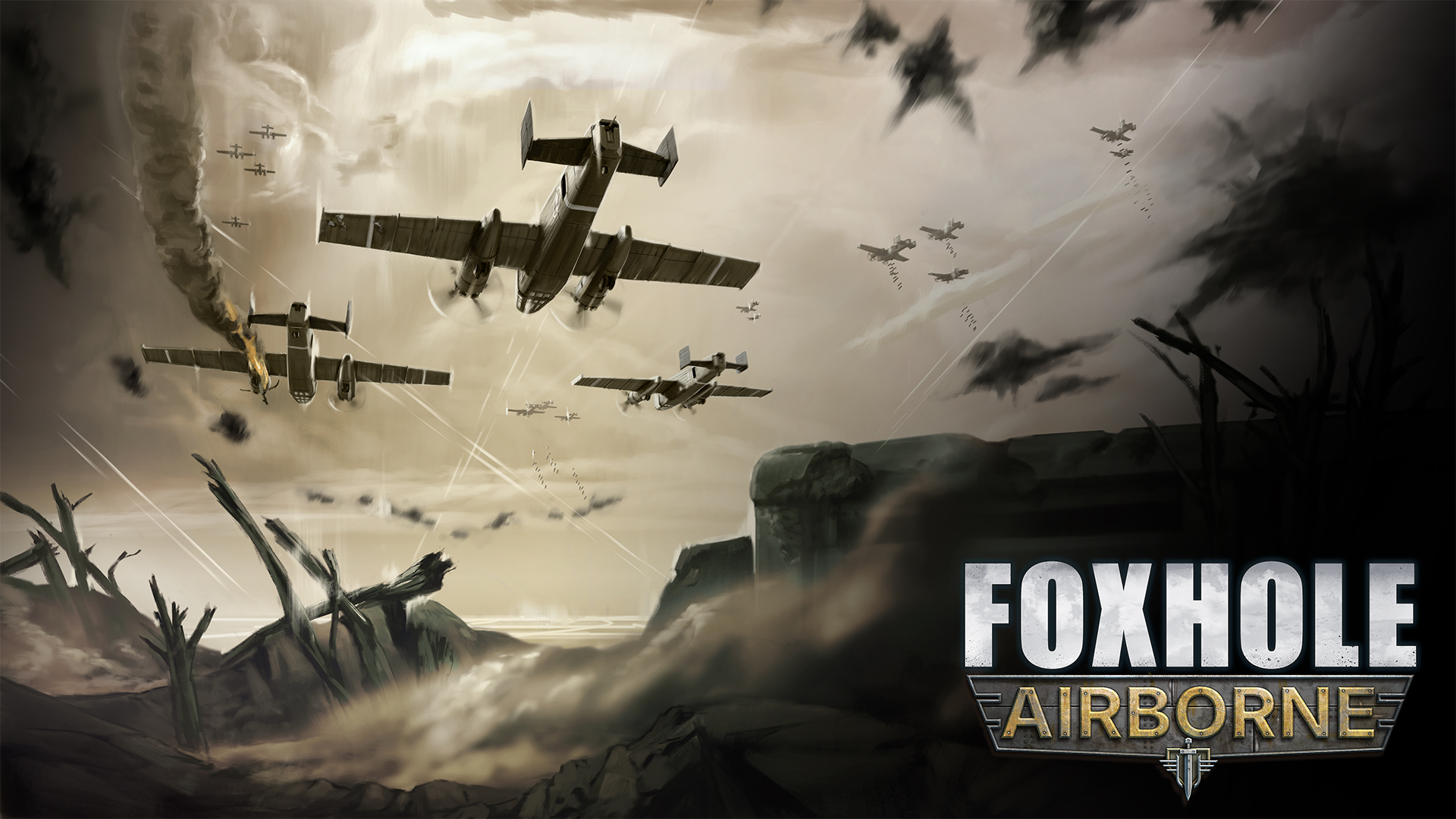
Source - foxhole.com
For over seven years, Foxhole, developed by Siege Camp, has been running one of the most ambitious persistent war simulations in modern gaming. It does not chase spectacle or cinematic bombast like Helldivers 2 or Battlefield. Instead, it builds something slower, heavier, and far more systemic: a fully player-driven war where every rifle, shell, vehicle, and bunker originates from human labor somewhere along the production chain.
The reason for revisiting Foxhole now is simple. After a cycle of yearly major updates, Siege Camp has spent the past two years developing what may be its most transformative expansion yet. The new airforce update fundamentally reshapes the strategic layer of the war, introducing aerial logistics and combat in a way that reconfigures frontlines and infrastructure alike. Even the earlier naval overhaul, which dramatically expanded maritime warfare and coastal operations, did not alter the strategic landscape this drastically.
Having participated, somewhat proudly, in War 100, perhaps the most iconic and second longest war in the game’s history, I have seen Foxhole at both its most triumphant and its most exhausting. With the airforce update now live and the war machine recalibrated once again, this feels like the right moment to evaluate Foxhole not as a niche experiment, but as a living system that continues to evolve in scale and ambition.
NARRATIVE - 20
Foxhole does not present a traditional plot. There are no named protagonists, no cinematic arcs, no scripted turning points that guide the player from beginning to end. Instead, the game offers a persistent war between two factions, the Wardens and the Colonials, framed through fragments of lore and historical suggestion rather than explicit storytelling. Both factions draw clear aesthetic and ideological inspiration from early twentieth century warfare, echoing elements of World War I and World War II uniforms, industry, and military doctrine. These references are deliberately mixed and reconfigured, preventing any clean one to one parallel with real world nations. The result is a world that feels historically grounded yet distinct, old and industrial, ideologically divided, but unmistakably its own. Something very akin to Dishonored’s worldbuilding and setting.

Created by Csp499
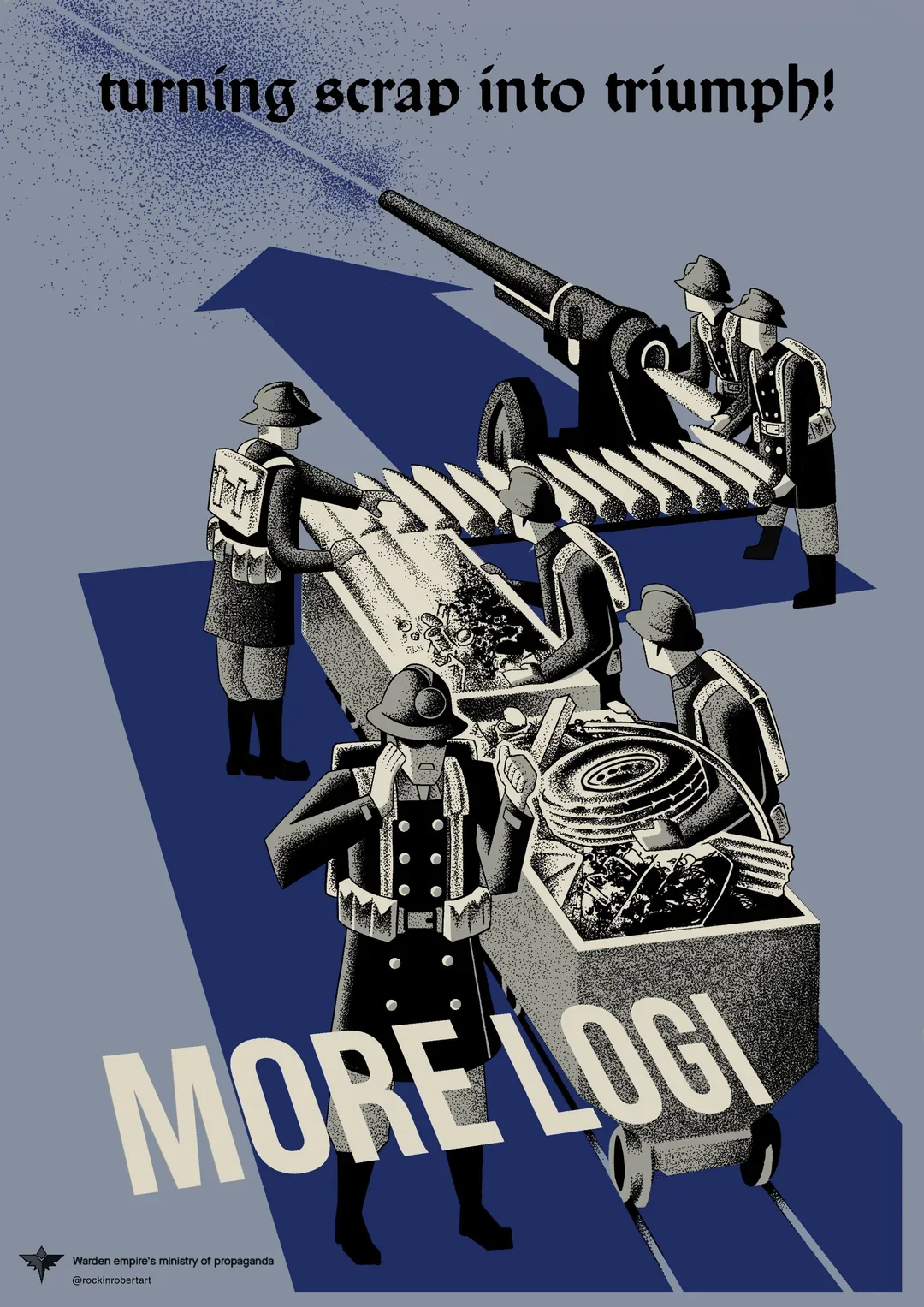
The implicative nature of its storytelling is strengthened through worldbuilding details scattered across the game, a method often used in Fromsoft’s “soulsborne” games. Vehicles, weapons, and structures often include short descriptive texts that hint at technological evolution, faction philosophy, or past conflicts. Uniform designs, architectural styles, and industrial aesthetics subtly distinguish the two sides. Over time, players themselves amplify these distinctions. Faction loyalists create propaganda, memes circulate within the community, and certain large scale military achievements become semi-mythologized. Some regiments are spoken of with a reverence that borders on canonization. Foxhole’s narrative does not unfold in cutscenes; it accumulates in shared memory. Much of it is discovered, debated, or even rejected by the community. The story exists, but it remains deliberately understated, embedded in tone and texture rather than delivered through traditional narrative devices.
This restrained approach to narrative fits Foxhole perfectly. A more explicit plot, layered over weeks long wars shaped by thousands of players, would likely feel artificial and intrusive. The absence of a fixed storyline allows the setting to breathe and the conflict to remain flexible. Lore exists to provide texture and identity, not to dictate interpretation. In a game where persistence and participation define meaning, subtle worldbuilding proves more powerful than scripted drama. For that reason, Foxhole earns full marks in this category. It understands exactly how much narrative it needs, and more importantly, how much it does not.
Visuals & music - 15
This is perhaps Foxhole’s weakest category, though not for lack of artistic intent. The game’s art direction is strong and cohesive. Uniforms, vehicles, architecture, and terrain all reflect its industrial war setting with clarity and consistency. The problem lies more in technical execution. Graphically, the game is beginning to show its age. Textures are functional rather than detailed, animations are serviceable, and environmental variety can feel limited after extended play. None of this breaks immersion, but neither does it elevate the visual layer beyond competence.
Music occupies a similarly restrained role. It is not central to the Foxhole experience, and most of the game unfolds without a constant orchestral presence. However, each faction’s anthem, played in the home region and deployment areas, carries surprising emotional weight. Those brief musical moments reinforce belonging and faction identity, shaping the psychological transition from player to soldier. Sound design follows the same philosophy as the visuals. Gunfire, artillery, engines, and explosions serve the battlefield well, yet rarely stand out as memorable in isolation. Large scale engagements can look and sound chaotic, with smoke, particle effects, and artillery explosions and craters creating genuine frontline spectacle. The weight is there. The polish, at least by modern standards, is more modest.
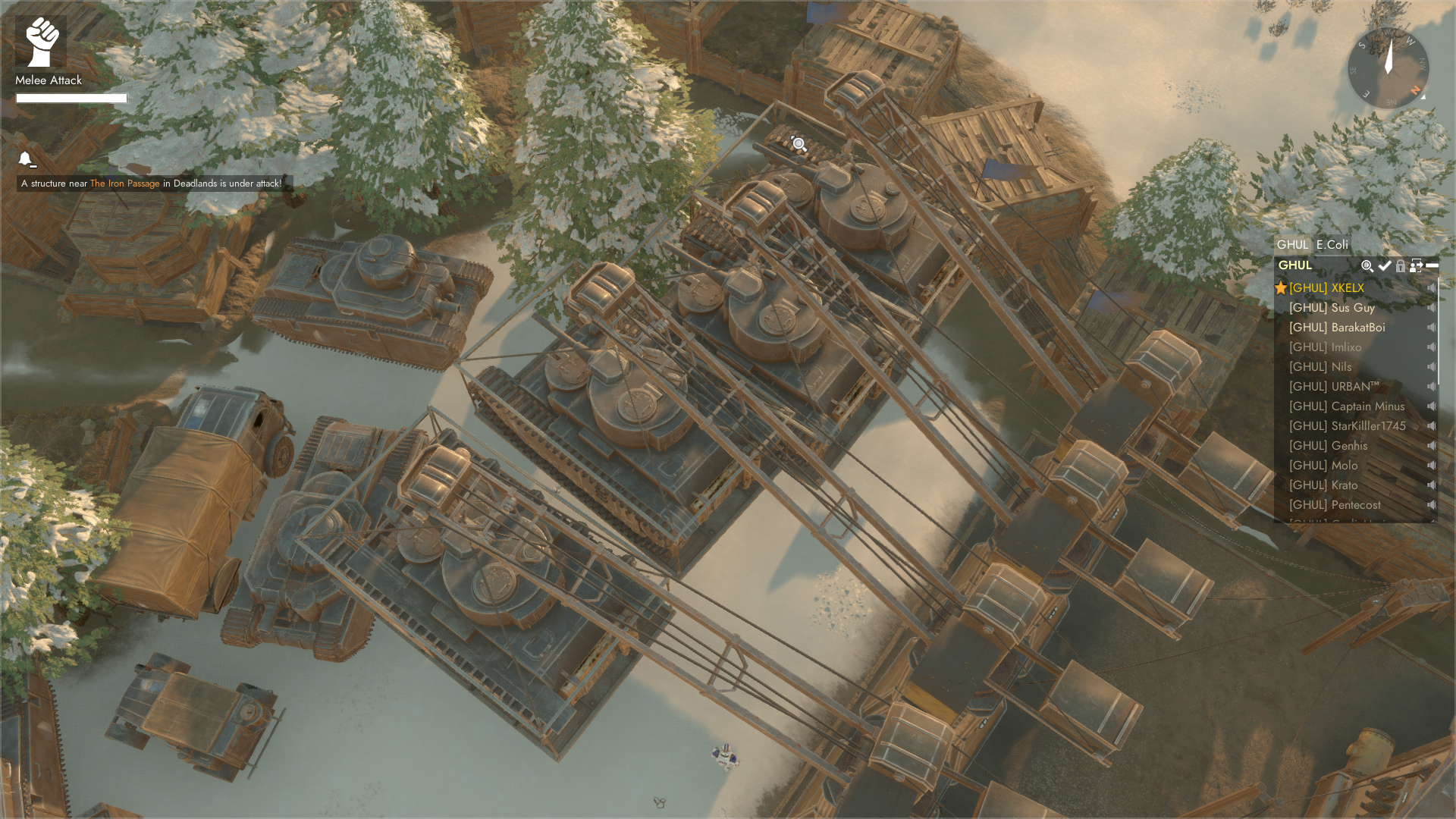
Cranes lifting Warden Main Battle Tanks in a logistical facility - War 100
Mechanics - 18
Foxhole’s mechanics are best understood in three interconnected layers: persistence and scale, production and logistics, and frontline combat and infrastructure. The reason for grouping them this way lies in the sheer mechanical breadth of the game. Players can mine resources, refine materials, manufacture equipment, transport supplies, construct fortifications, crew armored vehicles, coordinate artillery, pilot aircraft, or fight on the frontline. Few war games distribute responsibility across so many systems. Understanding Foxhole mechanically therefore requires stepping back and examining how these layers interact rather than isolating them as separate features.
The first layer, persistence and scale, defines the war itself. The wars unfold across a massive, region based map that remains active for weeks at a time. Territory changes hands gradually, region by region, city by city, through sustained pressure rather than sudden victory screens. Forward bases require maintenance, supply routes must remain functional, and neglected infrastructure decays over time. There is no match reset to wipe the slate clean. Every gain or loss leaves a mark. This persistence transforms geography into a mechanical variable. Distance matters. Terrain matters. Time matters. And most importantly, cooperation matters.
The second layer, production and logistics, forms the industrial backbone of the war. Raw materials are mined by players, transported to refineries, processed into usable resources, manufactured into equipment, and delivered to the front. Every rifle, shell, vehicle, and medical supply originates somewhere in this chain. Factories operate through queue systems. Fuel must be managed. Trucks, trains, and ships become as critical as tanks. The new airforce update extends this logic vertically, introducing aerial transport and combat that further complicate supply lines. The system is deep and remarkably coherent. It can also be unforgiving. Logistics requires patience, coordination, and time investment that not every player will find accessible, especially if working alone.
The third layer, combat and infrastructure, translates industrial capacity into frontline action. Infantry combat is deliberately restrained, with simple aiming, cover dependence, and limited ammunition. Vehicles demand coordination, often requiring multiple players to operate effectively. Construction systems allow players to build trenches, bunkers, artillery positions, and layered defenses that determine whether a frontline holds or collapses. Spectacle emerges from scale rather than mechanical flashiness. At times, interface friction, server strain, a steep learning curve and severe balancing issues, that stem from a developper wish for factional asymmetry, temper the experience, which prevents a perfect score. Yet the coherence of the overall system remains impressive.
Taken together, these mechanics create more than a simple shooter battlefield. They create a functioning war machine with a myriad of cogs that all need to turn in perfect sync to achieve success. The question that follows is not only how these systems operate, but what kind of player they produce when participation in industry becomes as important as participation in combat. That is where the analysis moves from mechanics into procedural rhetoric.
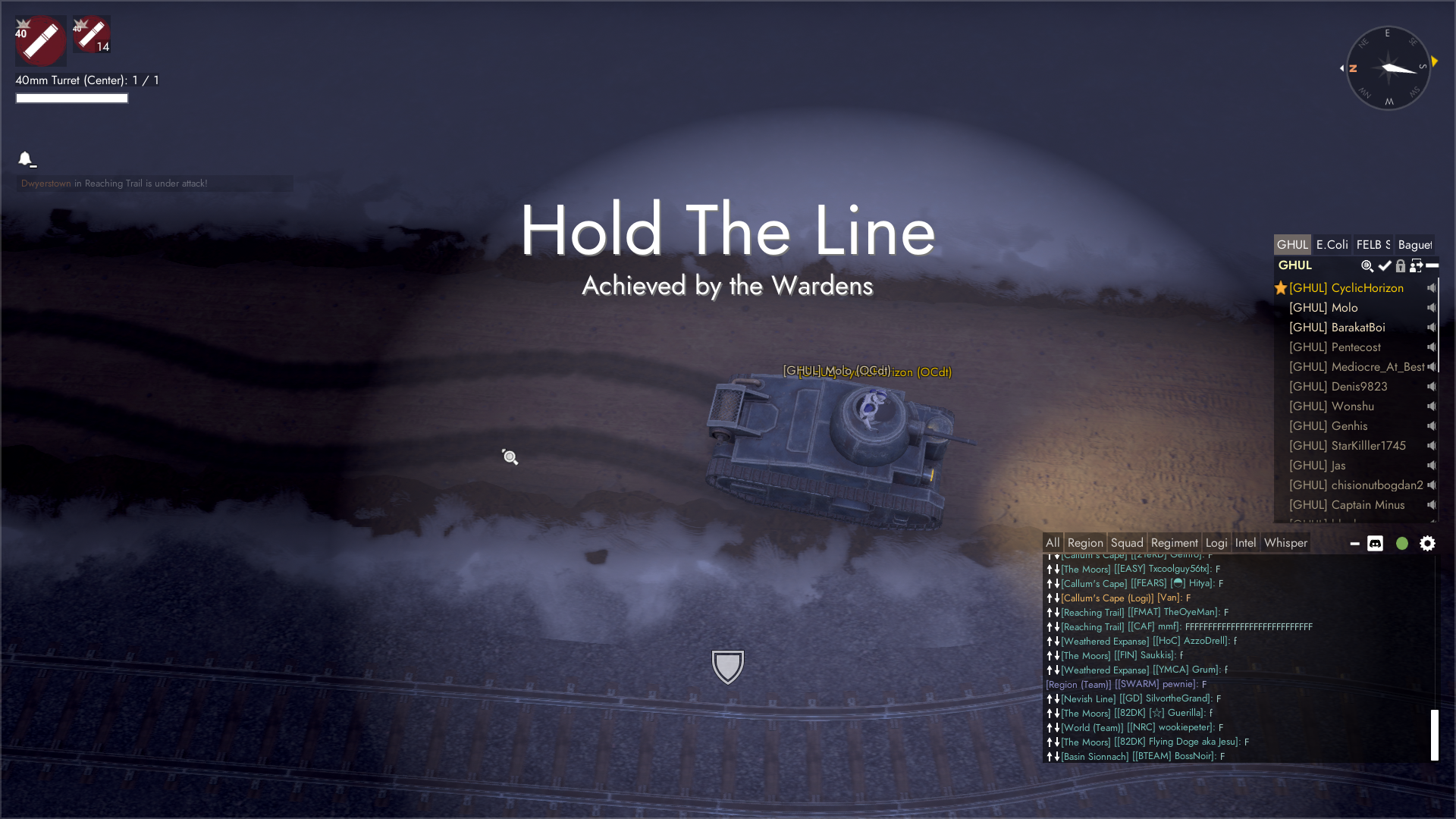
Wardens achieving a War Milestone against the Colonials - War 100
Procedural rhetoric - 20
Of course this would not be a PROC3SS review without examining Foxhole through procedural rhetoric. In our three strata model, this is the deepest layer, where mechanics move beyond function and begin shaping interpretation and identity. Foxhole contains so many persuasive systems that selecting only a few for analysis requires restraint. For the sake of clarity, we focus on two: the logistical supply chain and factional inhabitation. Both operate mechanically, yet both structure how players understand their role within the war.
The logistical chain is not decorative simulation. Every weapon, uniform, vehicle, and fortification must be mined, refined, manufactured, and delivered by players. Nothing spawns into existence without labor. This creates a feedback loop in which consumption is always tied to production. Firing artillery feels different when someone gathered the sulfur. Losing a tank carries weight when it required hours of coordinated industry. Through repetition, the system persuades players to value infrastructure, efficiency, and collective responsibility. The game is not verbally arguing that war is industrial and interdependent; it makes that reality unavoidable through mechanics. Subjectivity shifts from lone combatant to participant in an economy of effort.
The second persuasive layer operates through factional inhabitation. Although Foxhole lacks a scripted narrative, it continuously situates the player as a soldier of either the Wardens or the Colonials. Uniform design, equipment style, home region music, propaganda culture, and long term territorial struggle all reinforce identification. Because wars persist for weeks, loyalty develops through time invested rather than cutscene exposition. The game does not instruct players to care about their faction. It creates conditions in which care becomes practical. Resources are shared. Frontlines are defended collectively. Victories and defeats are remembered communally. This is procedural rhetoric because the argument is embedded in systems. Participation generates attachment. Through logistics and persistence, Foxhole persuades players to internalize factional belonging and collective duty without ever stating that they should.
On the surface, Foxhole may appear modest. Its visuals are restrained, its combat understated, and its presentation lacks the cinematic polish of larger budget war titles. Yet beneath that exterior lies one of the most ambitious mechanical experiments currently operating in the gaming industry. Few games commit so fully to systemic persuasion. Fewer still allow player labor, coordination, and loyalty to define the texture of the entire experience. Through persistence, logistics, and factional inhabitation, Foxhole constructs meaning without spectacle. In doing so, it achieves a level of mechanical ambition that quietly towers above many of its more visually impressive peers.
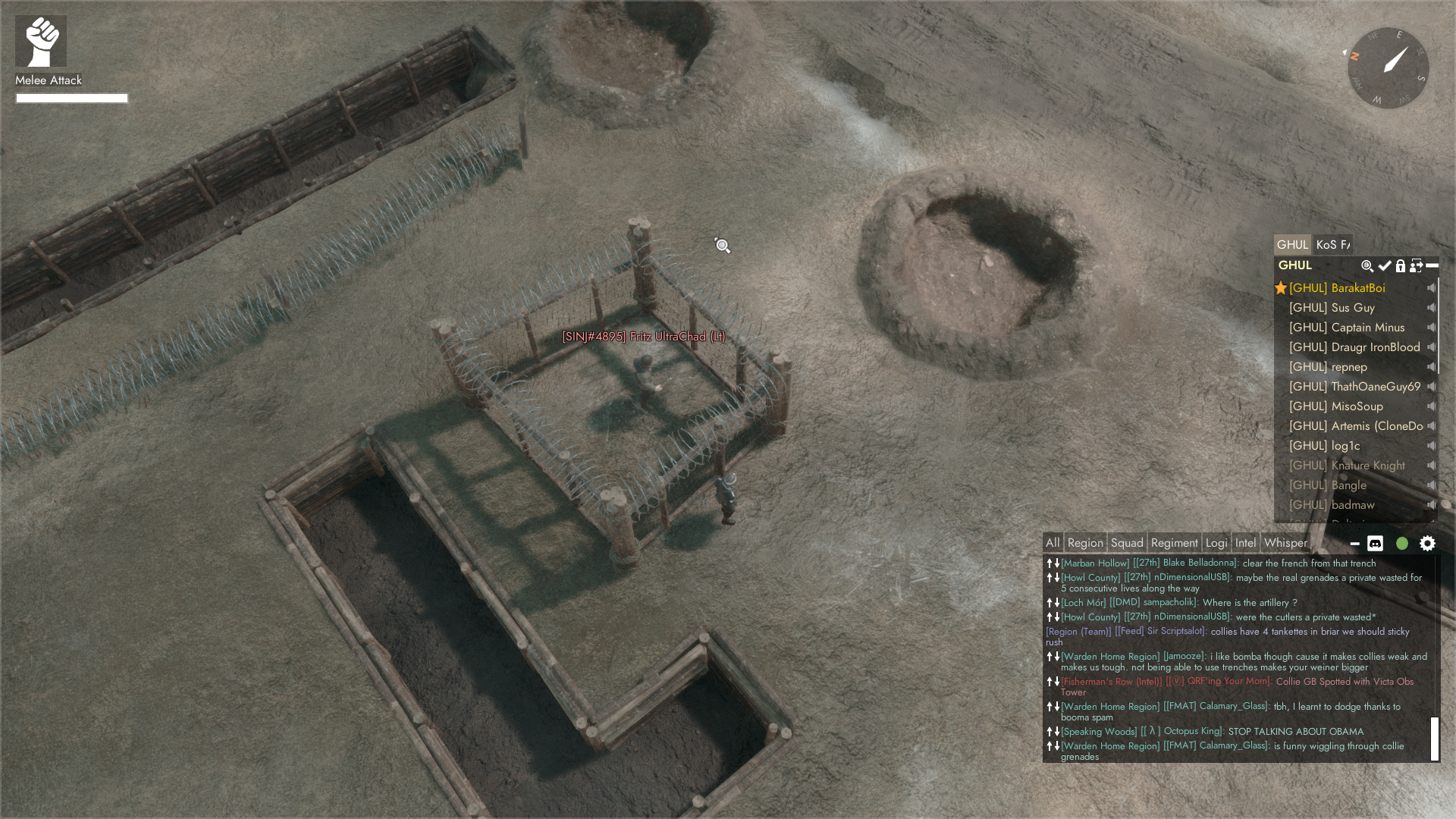
Wardens capturing a POW during the battle for Linn of Mercy - War 102
The foxhole experience - 20
Foxhole is difficult to learn and even harder to master. Its systems are opaque at first, its interface can feel unforgiving, and meaningful participation often requires patience. Yet once those layers begin to make sense, the experience becomes remarkably absorbing. It pulls you in and doesn’t let go until you’ve truly tried it all. Over the course of four months, I logged more than a five hundred hours. I joined friends, formed new alliances, led a regiment, recruited players, and fought through multiple wars. Very few games have managed to sustain that level of engagement.
Part of that pull comes from the fusion of strategy and consequence. Actions rarely feel disposable. Delivering supplies to a collapsing frontline, coordinating a defensive stand, or organizing a large scale push carries a tangible sense of impact. The war progresses because players act. Victories feel earned; defeats feel crushing yet instructive. The social dimension amplifies everything. Long nights on voice chat, shared setbacks, last minute breakthroughs, and the gradual formation of faction identity create a depth of involvement that extends beyond the screen. For all its friction and mechanical density, Foxhole achieves something rare. It makes participation feel meaningful.