
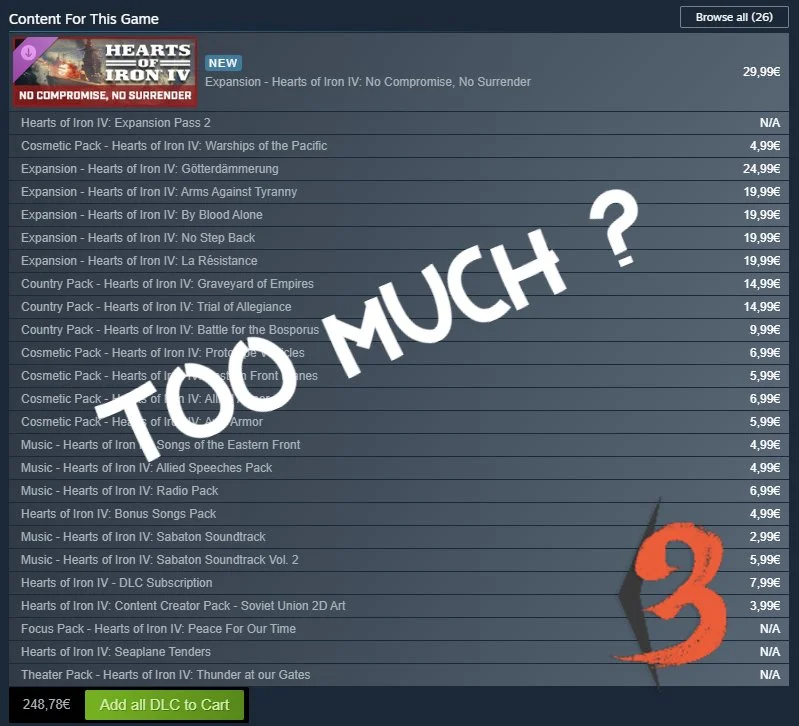
Few studios have tied their identity so closely to a business model as Paradox Interactive. Over the past decade, the company has built a reputation not only for grand strategy games, but for how those games evolve after release. Titles such as Europa Universalis IV, Hearts of Iron IV, and Crusader Kings III rarely exist in a fixed state. They grow, expand, and restructure themselves over time through a continuous stream of DLC and updates.For players unfamiliar with this model, the first encounter can be jarring. A game released years ago remains actively developed, surrounded by dozens of expansions, content packs, and mechanical overhauls. The cumulative price can be substantial. The structure feels less like a finished product and more like an ongoing subscription to complexity.
That perception is not entirely wrong, but it only captures part of what Paradox is doing.
From Game to Platform
Paradox titles are not designed as self-contained experiences. They function more like platforms, systems meant to be iterated on rather than completed. The initial release establishes a foundation, often relatively accessible compared to what the game will later become. Over time, expansions introduce new mechanics, deepen existing ones, and reshape how players interact with the system. Europa Universalis IV offers a clear example. At launch, it presented a broad historical simulation focused on diplomacy, warfare, and economic management. Years of DLC transformed that foundation into something far more intricate, layering in religious mechanics, trade systems, national focus trees, and region-specific depth. The result is a game that feels fundamentally different from its original version, despite sharing the same core. This transformation is not accidental. It is structural. Paradox designs its games with the expectation that they will evolve. DLC is not simply additional content, it is the primary vehicle through which the system matures.
The Cost of Depth
This approach creates a visible tension. On one side sits depth, a level of mechanical complexity that few studios attempt at this scale. On the other sits accessibility. As systems accumulate, the barrier to entry rises. A new player entering Hearts of Iron IV today is not stepping into the same game that launched years ago. They are entering a layered system shaped by expansions that assume a degree of familiarity. Mechanics that were once optional become expected knowledge. Interfaces grow denser. Decision making becomes more specialized. The financial cost mirrors this complexity. Owning the “complete” version of a Paradox game often requires purchasing numerous expansions. For long-term players, this cost is distributed over time, each DLC arriving as a manageable addition. For newcomers, it appears as a steep entry point, a wall of content that can feel overwhelming before the game even begins. This dual structure creates two distinct audiences. Veterans who experience growth alongside the game, and newcomers who encounter its accumulated form all at once.
Procedural Evolution
From a procedural perspective, Paradox’s model is particularly interesting. Most games deliver a fixed system that players learn, master, and eventually exhaust. Paradox games resist that closure. Each expansion modifies the rules, introduces new variables, and alters optimal strategies. The meaning of the game, what it persuades the player of, is therefore not static. It shifts over time. In Crusader Kings III, early gameplay emphasizes dynasty management and political maneuvering. Later expansions introduce deeper cultural systems, court mechanics, and roleplaying elements that reshape how players approach identity and power. The player is not simply engaging with more content, they are engaging with a different interpretation of the same system. This ongoing transformation creates a unique relationship between player and game. Mastery is temporary. Knowledge must be updated. Strategies that once worked may no longer apply. The system remains in motion, and the player must adapt alongside it.
Fragmentation and Community
The DLC model also affects how communities form and interact. Players do not always share the same version of the game. Differences in owned expansions can lead to variations in mechanics, available features, and overall experience. This fragmentation can complicate multiplayer environments and create uneven expectations between players. At the same time, it fosters a highly engaged community. Discussions around new expansions, balance changes, and emerging strategies remain active years after release. The game becomes a shared project, continuously interpreted and reinterpreted by its player base. Mods further amplify this dynamic. Paradox titles are known for their extensive modding communities, which often build on top of the existing DLC structure. The line between official expansion and community-driven content begins to blur, reinforcing the idea of the game as an evolving ecosystem rather than a fixed product.
Aggressive or Aligned
Criticism of Paradox’s DLC strategy often focuses on its aggressiveness, and there is truth in that assessment. The volume of content, the cumulative pricing, and the pace of releases can create fatigue. For some players, the model feels extractive, a constant push toward additional purchases. Yet this perspective becomes more complex when placed alongside the design of the games themselves. Paradox builds systems that benefit from long-term iteration. Their titles are not easily replaced by sequels without losing accumulated depth. Expansions allow the system to grow without resetting player progress or fragmenting the audience across multiple releases. The model, then, is not only economic. It is structural. The way Paradox monetizes its games aligns closely with how those games are designed to function.
fINAL THOUGHTS
Paradox Interactive occupies a unique position in the industry. Its DLC strategy is both a source of criticism and a key component of its success. The same approach that raises barriers for new players also enables a level of depth and longevity that few games achieve. Understanding this model requires looking beyond price tags and expansion counts. It requires recognizing that these games are not meant to end. They are meant to evolve. For players willing to engage with that evolution, the reward is a system that continues to grow long after its initial release. For others, the entry point may feel too steep, the commitment too demanding.
Both reactions are valid. They reflect two sides of the same design philosophy.
