
Indie Spotlight | PROC3SS
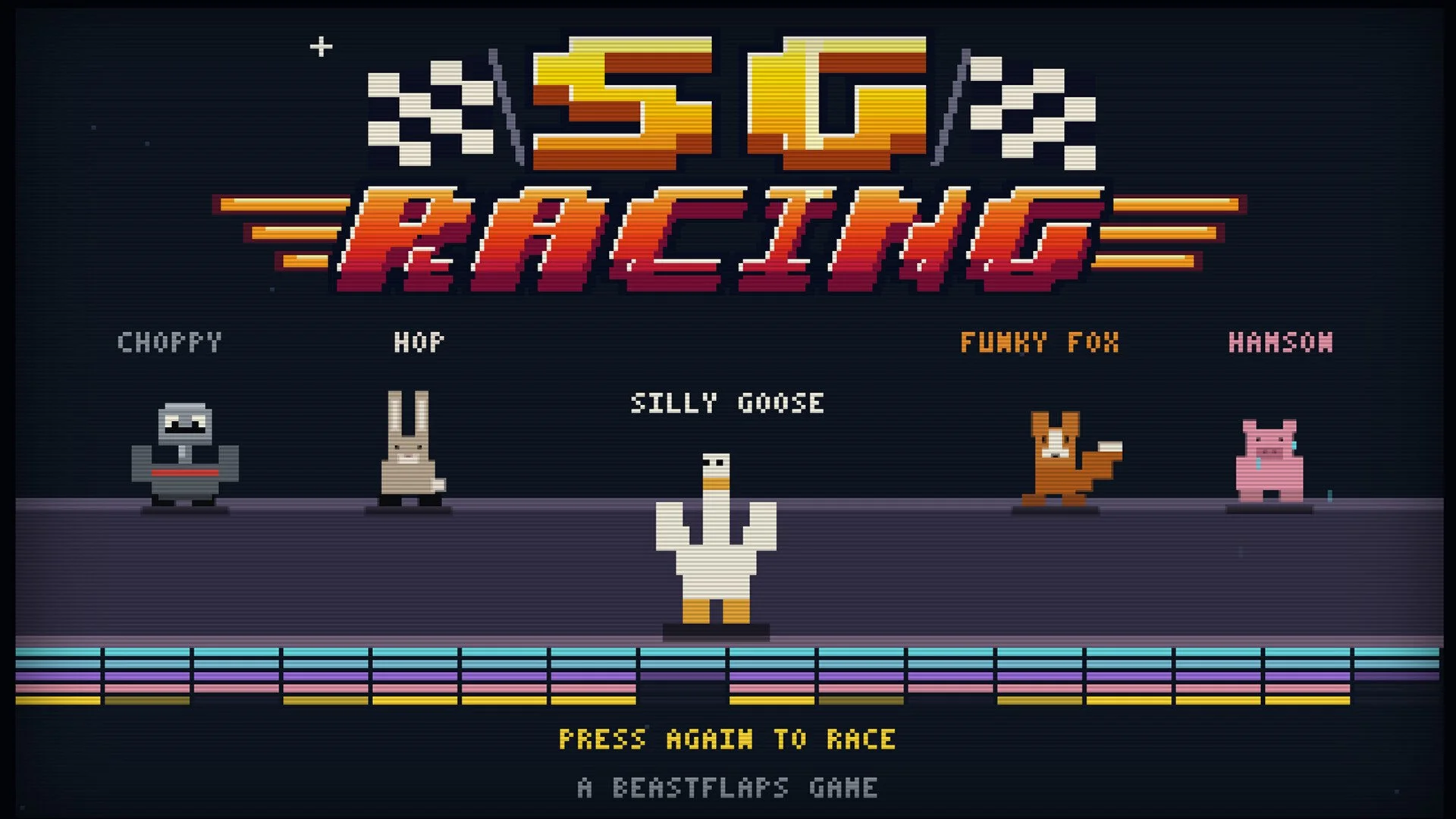
Arcade racing games have always relied on a deceptively simple premise: get behind the wheel, learn the controls, and make it to the finish line. Their appeal often comes from how quickly players can understand what is expected of them, while the challenge lies in learning how to execute it. SG Racing, a top-down pixel-art kart racer developed by Beastflaps Games, embraces this philosophy with straightforward controls, weighty handling, and a selection of unconventional stunt modes designed to introduce a little chaos into the familiar racing formula. Featuring six racing worlds, power-ups, and local two-player support, the game presents itself as a lighthearted arcade experience built around accessibility and experimentation. After spending some time with SG Racing and speaking with its developer about the design decisions behind it, we found an enjoyable foundation with a distinct personality, although one that occasionally struggles to sustain its initial appeal.
Back to Arcade Fundamentals
SG Racing makes a good first impression through the simplicity of its controls. The basic mechanics are immediately understandable, allowing players to get into a race without spending much time learning complicated systems. However, the handling introduces an interesting contrast to that accessibility. Vehicles feel surprisingly heavy, and mastering their movement takes considerably more practice than the control scheme initially suggests. This weight gives the racing a certain character, making precision and familiarity with the vehicle important even when the underlying inputs remain straightforward. According to the developer, this balance was intentional. "I wanted SG Racing to be easy to get into, fun to play and a bit silly. Something you can pick up in seconds but still get better at." He also explained that drifting, traction, speed, power-ups, and track knowledge all contribute to the game's underlying mechanical depth. There is certainly satisfaction to be found in gradually understanding the handling, particularly when a difficult maneuver begins to feel more natural. At the same time, the relatively simple gameplay loop places considerable responsibility on those mechanics to keep the experience engaging, and the novelty can begin to fade once the fundamentals become familiar.
Stunt Modes and the Limits of Control
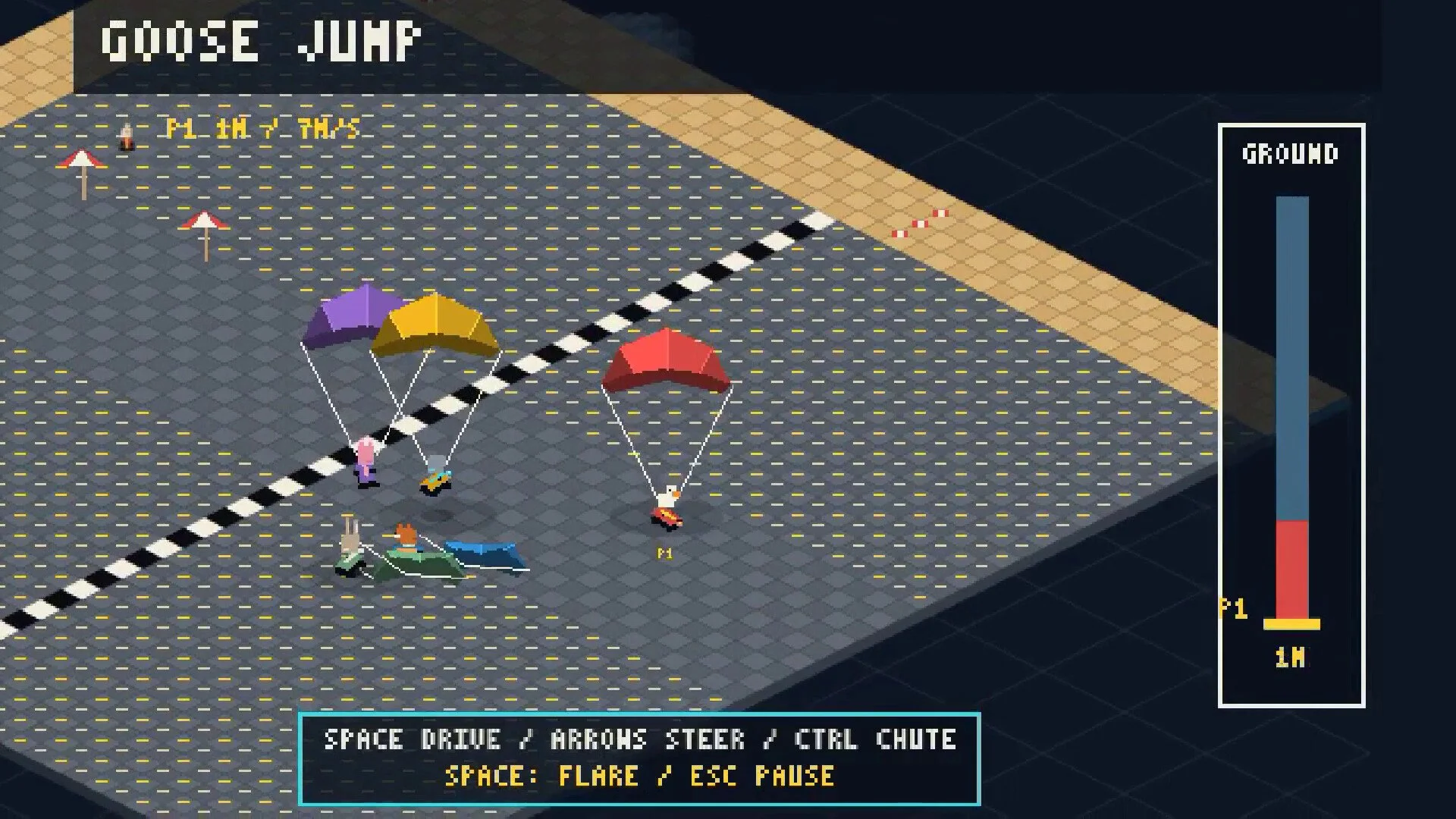
Beyond traditional racing, SG Racing introduces additional stunt modes that experiment with different forms of player control. In Stunt Goose, players must consider speed and mid-air tilt while attempting to clear a row of buses, whereas Goose Jump introduces variables such as distance, wind, and parachute timing. These modes provide some welcome variety, changing the player's immediate objective from navigating a racing circuit to managing the conditions of a single stunt. The developer explained that he wanted players to feel in control without always knowing exactly how their actions would unfold, adding that "sometimes experimenting gets you further than playing it safe." This philosophy is evident in the way the stunt modes encourage repeated attempts and small adjustments. There is an enjoyable element of unpredictability, particularly when a seemingly reasonable approach produces an unexpected result. However, the modes remain relatively barebones, and their simplicity limits how long they can sustain interest. They work best as brief diversions from the main racing experience, offering a few amusing moments and opportunities for experimentation before their mechanics become familiar.
Failure as Part of the Entertainment
One of the more interesting aspects of SG Racing's design philosophy is its approach to failure. Arcade games have traditionally used repeated attempts as a means of encouraging mastery, and SG Racing follows a similar principle while placing greater emphasis on the entertainment value of getting things wrong. "Failing can be funny, especially in the stunt modes," the developer explained. "I wanted people to try different approaches and see what worked. It's easy enough to have another go." The short and accessible nature of these challenges makes experimentation relatively painless, allowing players to adjust their approach without committing to lengthy sequences of gameplay. From a procedural rhetoric perspective, the game encourages an understanding of failure as part of the learning process. Success emerges through familiarity with the mechanics, repeated attempts, and the occasional willingness to try something unconventional. There is a playful quality to this relationship between action and consequence, although the relatively limited complexity of the stunt modes means that experimentation eventually encounters diminishing returns. Once players have explored the available possibilities, the experience offers fewer reasons to continue testing them.
Pixel Art, Personality, and Presentation
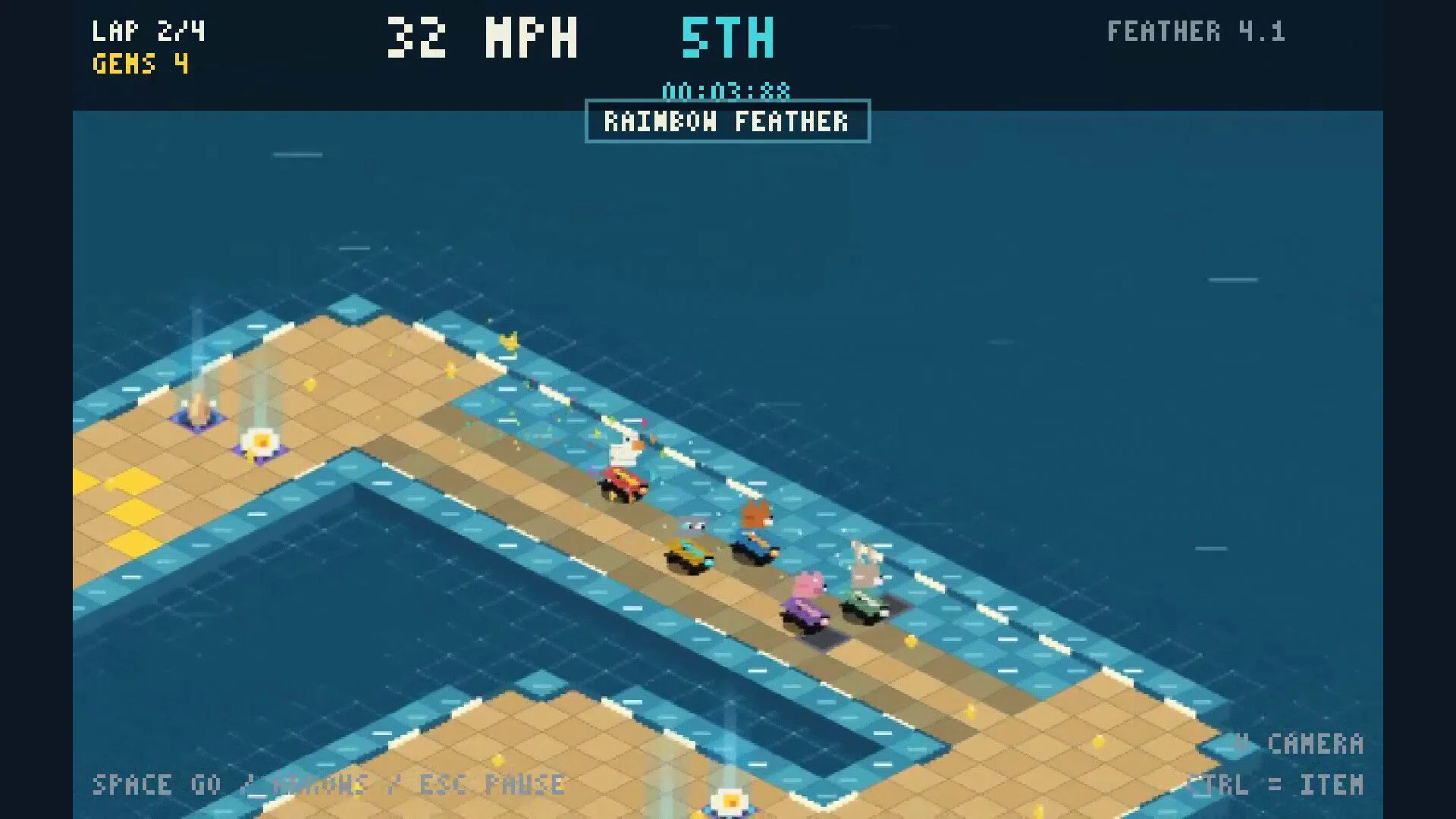
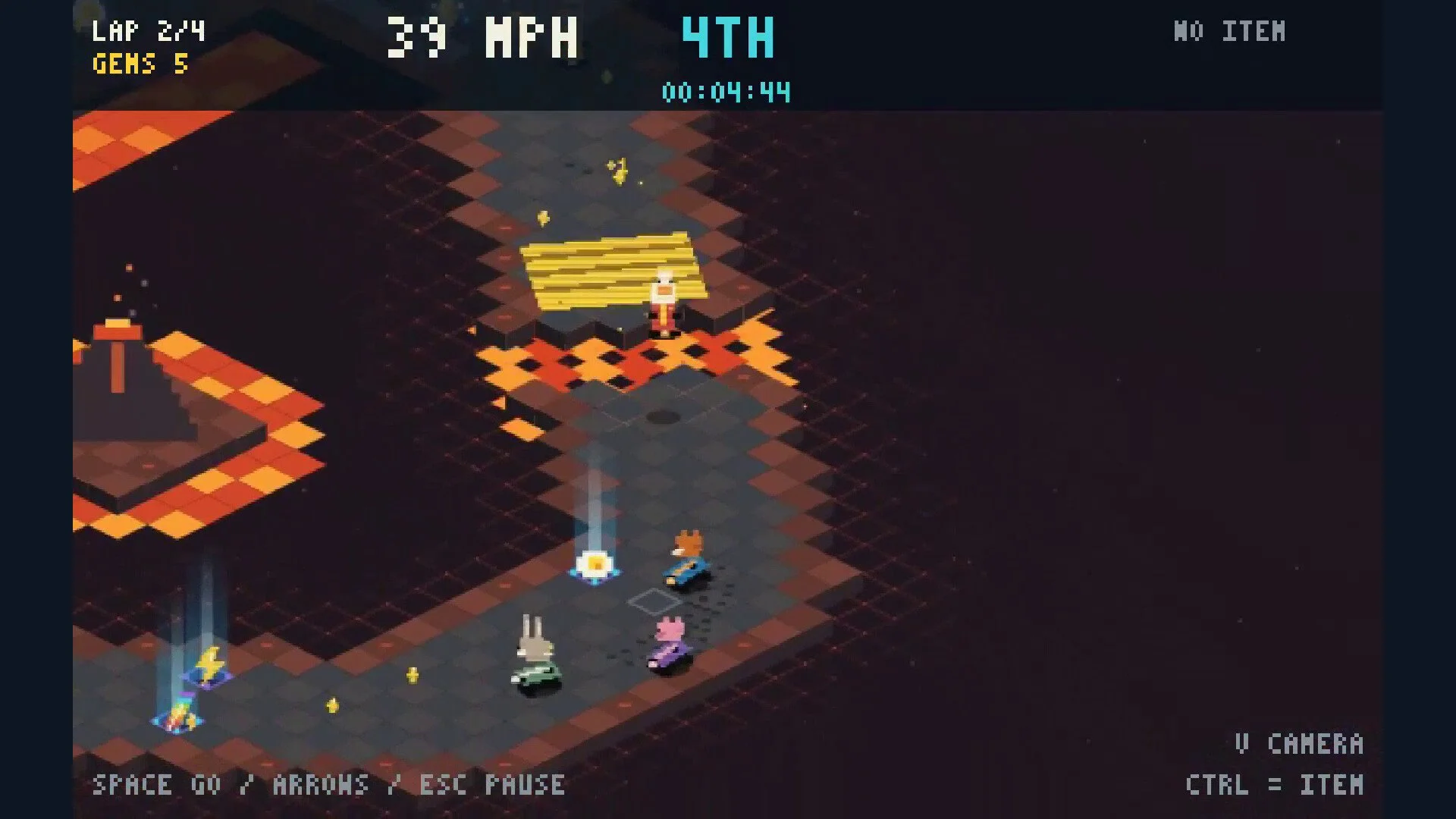
Visually, SG Racing embraces the charm of traditional pixel-art games, drawing on the aesthetics of older arcade racers while introducing its own characters and playful identity. The artistic direction suits the game's straightforward approach, giving the environments and vehicles a recognizable style without overwhelming the screen with unnecessary detail. The developer cited his fondness for classic arcade racing games and pixel art as major influences, explaining that he wanted to capture their immediacy while incorporating his own ideas. The result is an appealing presentation that complements the game's lighthearted personality. There are, however, opportunities to improve the way players experience that presentation. Most notably, an adjustable field-of-view or camera zoom setting would offer greater flexibility, allowing players to choose how much of the surrounding track they want visible at once. This would be particularly welcome in a top-down racer where anticipating upcoming turns and positioning the vehicle are important parts of the experience. The visual foundation is appealing, and additional customization could help players engage with it more comfortably.
Behind the Wheel: Developing SG Racing
Although SG Racing appears mechanically straightforward, the developer's answers reveal how much attention went into refining its underlying systems. When asked about the greatest development challenge, he identified the racing physics, particularly achieving smooth movement, satisfying drifting, and fair competition. These are the kinds of details that can easily go unnoticed when they function correctly, yet they have a substantial influence on how a racing game feels. He also shared that his children regularly playtest SG Racing and are particularly good at discovering problems he had overlooked. It is a charming detail that reflects the personal nature of independent game development, where feedback can come from the people closest to the creator. Their involvement also seems fitting for a game whose greatest strength may lie in its accessibility as a shared experience. With local two-player support and mechanics that can be understood almost immediately, SG Racing has the qualities of a casual couch game that friends and family can enjoy together. Its simplicity becomes more appealing in this context, where the entertainment comes as much from the interaction between players as from the game itself.
Final Impressions: A Promising Arcade Foundation
SG Racing is an enjoyable little arcade racer with a clear sense of direction. Its accessible controls, surprisingly demanding handling, charming pixel-art presentation, and playful stunt modes create a foundation that is easy to appreciate. The developer's emphasis on experimentation, quick retries, and gradual mastery is reflected in the mechanics, particularly in the way the game encourages players to learn through repeated attempts. However, the experience remains relatively limited in scope, and the gameplay loop can become repetitive over longer sessions. The stunt modes provide some additional entertainment, although their simplicity means they are unlikely to sustain prolonged engagement on their own. Where SG Racing feels most at home is as a casual multiplayer experience, something to pick up for a few races with friends or family before moving on to something else. There is genuine promise in its design, and further development of its mechanics, variety, and presentation could help that promise translate into greater longevity. For now, SG Racing offers a modest but entertaining reminder that accessible arcade games can still be enjoyable, even when their ambitions remain relatively small.
SG Racing is developed by Beastflaps Games. PROC3SS received a complimentary review key from the developer. The developer's responses were provided directly to PROC3SS as part of our coverage.
