Plato once imagined a ruler who governed not through ambition or personal gain, but through knowledge. The philosopher king, a sovereign who understands the systems that sustain a society and shapes them wisely. Few games capture that fantasy of governance quite like Songs of Syx. Most stop somewhere along the way. Settlements remain villages, colonies stay small, and populations rarely reach numbers that feel particularly meaningful to the player. Songs of Syx takes the opposite approach. It begins with a fragile settlement of a about a dozen citizens and quietly invites the player to grow it into something enormous. Thousands of citizens can inhabit a single city. Entire districts emerge around industry, trade, military infrastructure, and housing. What starts as a handful of huts can eventually resemble a living capital.
Developed by a single creator, Songs of Syx blends several traditions of strategy design into one unusually ambitious package. It shares the large-scale battles of Total War, the room-based management and production chains of Dungeon Keeper, the systemic complexity often associated with Dwarf Fortress, and the colony aspects of RimWorld. Yet it does not replicate any of them directly. Instead, it combines city building, economic simulation, and state governance into a single continuous system where population scale becomes the defining feature.
The result is a strategy game that feels less like managing a colony and more like governing a greek city-state from antiquity. Growth is constant, pressure is relentless, and the player is responsible for nearly every structural decision shaping the city. Beneath the top-down interface lies a dense network of mechanics that do more than simulate governance. They invite the player to rule.
NARRATIVE - 17
Songs of Syx does not follow a traditional narrative structure. There are no scripted storylines, no predefined characters guiding the player through events. This absence is intentional. As a city-state simulation with RTS warfare elements, the game places narrative authority almost entirely in the hands of the player. The story emerges from governance decisions rather than authored plot.
Where the game does provide narrative texture is through its worldbuilding. Several distinct races inhabit the world, each with their own attributes, preferences, and historical background. Importantly, the game does not restrict the player to a mono-cultural settlement. Multiple races can coexist within the same city, bringing with them different strengths, needs, and social dynamics. These differences are not merely cosmetic. They influence labor efficiency, happiness, and long-term stability. A diverse population can be a source of prosperity or tension depending on how it is managed.
The result is a narrative that unfolds through political and economic choices. A player may shape their city-state into a commercial hub fueled by trade and production, or into an expansionist power that projects military force across the region. Songs of Syx provides the systems; the player writes the history. Even the world itself reinforces this sense of emergent storytelling. Each campaign takes place on a procedurally generated map, meaning there is no fixed world shared by all players. Every settlement develops within its own geographical and political context.
This approach suits the game well. The lore that exists gives flavor and identity to the races and the broader setting, while the absence of a rigid narrative framework allows the city-state itself to become the story. As development continues, deeper exploration of the races’ histories and cultural tensions could hopefully enrich this foundation even further.
VISUALS & MUSIC - 15
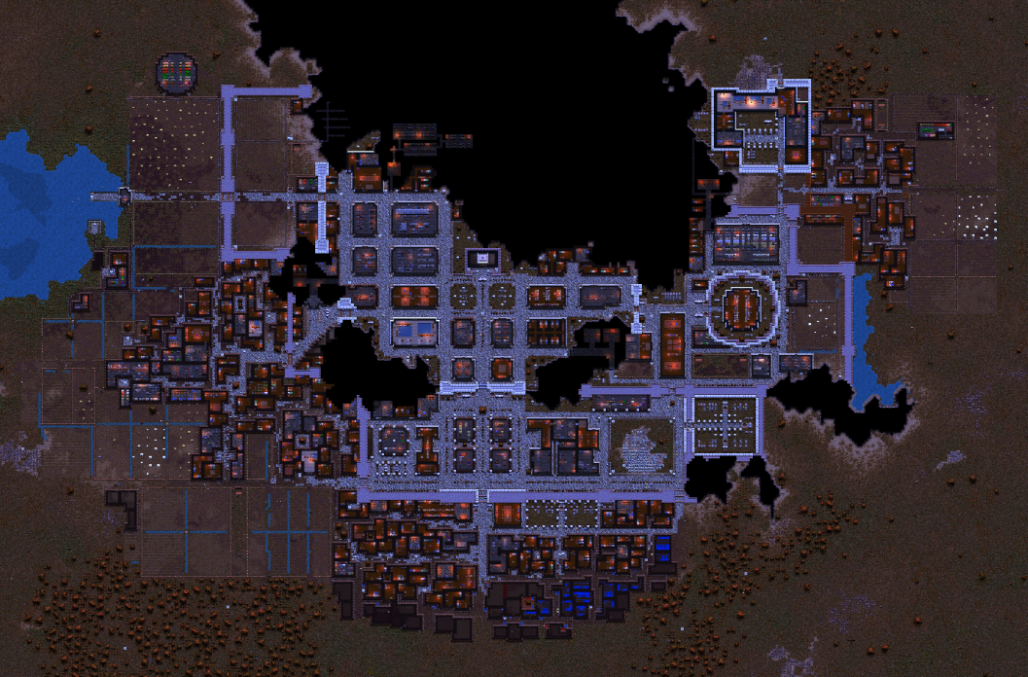
Visual presentation is not the main attraction of Songs of Syx, yet the game still manages to establish a distinct identity. At first glance the graphics feel modest, even understated. The top-down perspective, pixel-style citizens, and interface-heavy screen evoke strategy titles from the 1990s. Yet there is something undeniably modern in how the game renders scale. Thousands of citizens move through streets, fields, and production districts simultaneously. Massive battle lines stretch across the terrain when armies collide. The aesthetic sits somewhere between nostalgic and contemporary, simple in individual detail but impressive in the density of activity it can display. Especially in it’s combat simulation.
This visual approach suits the game’s ambitions. The goal is not cinematic spectacle, but clarity across enormous populations and complex logistics. Streets fill with workers moving between industries, farms sprawl across the outskirts of the city, and districts develop distinct visual patterns depending on their function. Over time the settlement begins to resemble an actual city-state rather than a neatly arranged builder grid.
Audio plays a more subdued role. Sound effects exist primarily to support the simulation rather than command attention. Citizens bustle, industries hum, and battles produce the expected clash of arms. The soundtrack follows a similar philosophy. It is atmospheric and unobtrusive, yet rarely memorable on its own. In a game where the player spends hours focused on economic flows, urban planning, and population management, this restraint arguably works in its favor. The audio never distracts from the systems driving the experience, even if it rarely stands out as a defining element.
Mechanics - 20
Songs of Syx is an extraordinarily dense game mechanically, and attempting to catalogue every system would quickly turn this section into a manual rather than a review. Population management, industry chains, trade networks, taxation, diplomacy, research, infrastructure planning, army logistics, regional conquest, religion, law enforcement, and urban planning all intersect in ways that make the city feel like a living organism rather than a static settlement. The player is constantly balancing growth with stability. Expand too quickly and supply chains collapse. Ignore citizen needs and unrest spreads through the population. Every system connects to several others, which is precisely what gives the game its depth.
Rather than attempting to describe every mechanic individually, we’ll look at the three areas where the game’s systems feel most distinctive: warfare, logistics, and the internal social structure of the city itself.
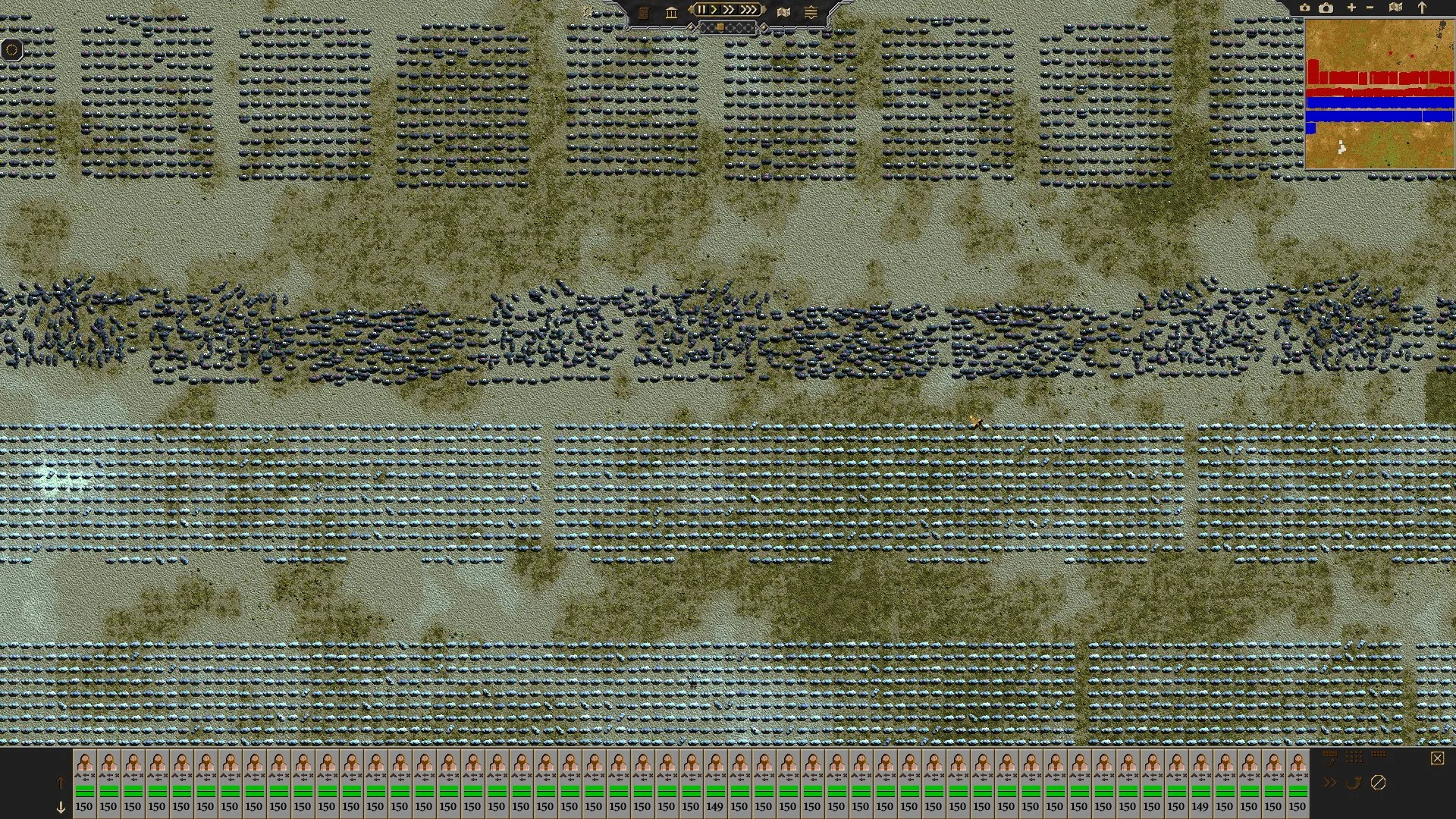
Combat operates at two levels. Internally, citizens can be trained into soldiers who form professional divisions drawn directly from the population. Training grounds prepare them, equipment must be manufactured, and maintaining an army removes workers from the economic base of the city. Externally, these divisions can be deployed on the campaign map to conquer neighboring regions, expanding the territory and influence of your city-state. Battles themselves unfold in real-time with up to thousands of soldiers forming lines across the battlefield. Positioning, morale, and numbers matter more than individual micromanagement. The result feels closer to a simplified grand strategy engagement than a traditional RTS skirmish, emphasizing scale and logistics rather than rapid tactical inputs. However this does mean those inputs don’t exist. Quite on the contrary, the RTS mechanics are fleshed out and intuitive.
Logistics form the invisible backbone of the entire city. Production buildings generate goods, but those goods do not automatically reach the population. Warehouses must be strategically placed throughout the settlement to collect resources from industry and redistribute them where they are needed. Food must reach homes, markets, eateries and taverns. Raw materials must reach workshops. Military equipment must reach barracks and supply depots. If warehouses are poorly positioned or poorly staffed, entire sections of the city can stall despite production being technically sufficient. Watching the flow of goods across the city becomes an essential management skill.
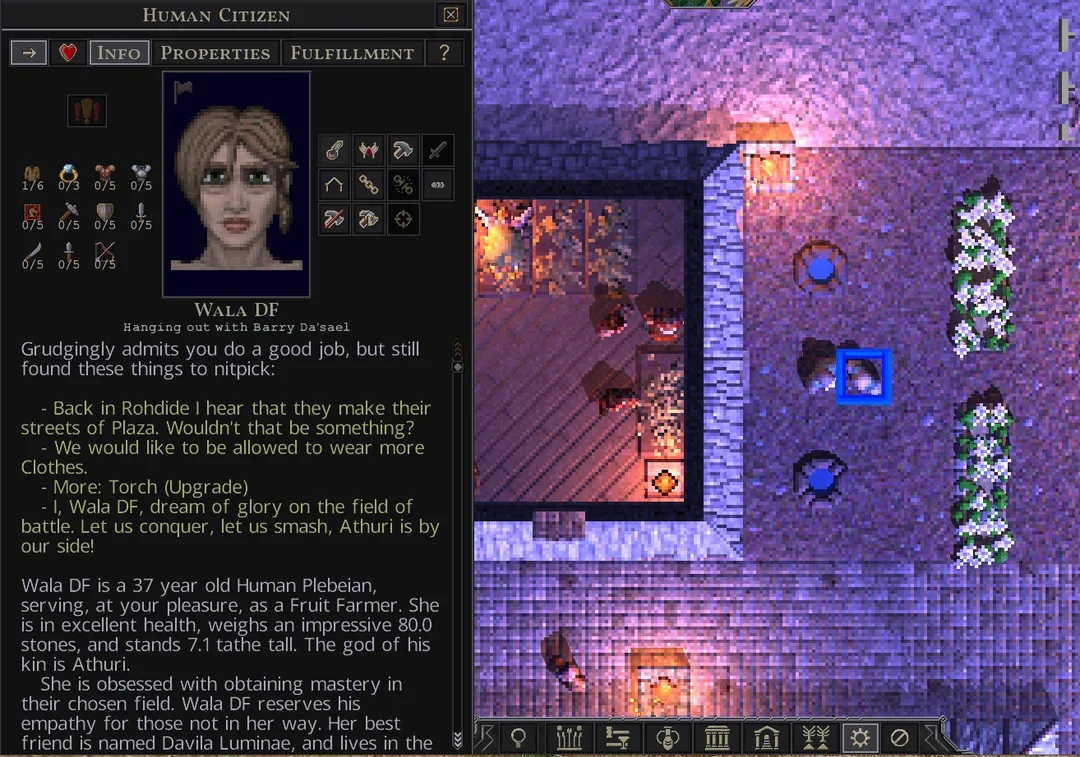
The final major layer concerns the citizens themselves. Population management goes far beyond simple housing and employment. Different races possess unique strengths, preferences, and cultural expectations, which means the composition of your population has direct consequences on productivity and stability. Some races thrive in certain industries while others dislike particular living conditions. On top of this sits a nobility system. As the city grows, powerful nobles demand estates, influence, and administrative authority over sectors of the state. Granting them power unlocks benefits and administrative efficiency, but it also introduces political complexity. The ruler is no longer managing only workers, but elites whose ambitions shape the structure of governance.
The social structure of the population adds another layer of complexity. Races do not always coexist harmoniously, and managing a multi-species city-state requires careful political balancing. Some populations tolerate each other easily, while others generate tension when forced into close proximity. The game also allows systems such as slavery, which different races react to very differently. Tilapi, for instance, are largely indifferent or even supportive of it, while humans strongly resent its presence. Others, such as the insectoid race. the Garthimis, remain mostly unaffected due to their limited social expectations. These differences turn population management into more than a logistical problem. It becomes a question of governance and social order within the city itself.
These mechanics only scratch the surface of what Songs of Syx offers. The important takeaway is not the sheer number of systems, but how interdependent they are. Military expansion depends on population growth. Population growth depends on supply chains. Supply chains depend on urban planning and labor distribution. The player is not simply building a city. They are maintaining a complex state apparatus where every decision ripples through the entire system.
PROCEDUral rhetoric - 20
Of course this would not be a PROC3SS review without examining the procedural rhetoric of Songs of Syx. Interestingly, the game sits in a somewhat unusual position. It grants the player such an immense degree of agency that its rhetoric becomes less prescriptive than in many other strategy games. Songs of Syx rarely forces a specific ideology upon the player. Instead, it provides a vast toolkit of systems and lets governance emerge from how the player chooses to use them.
Yet even in such an open simulation, mechanics still carry arguments.
The first appears in the relationship between population and power. Growth is not simply a measure of success; it is the foundation of everything the state can achieve. Industry requires workers. Armies require recruits. Infrastructure requires labor. Expansion therefore becomes almost inevitable. A city of a few hundred citizens struggles to sustain even basic industry, while a city of several thousand begins to resemble a functioning state capable of projecting power outward. Through its mechanics, the game quietly persuades the player that population scale is the true engine of political strength.
Logistics reinforce a second argument: prosperity is a product of organization rather than abundance. Resources alone are not enough. A settlement can produce plenty of food, yet still experience shortages if warehouses are poorly positioned or understaffed. The player quickly learns that the true challenge of governance is coordination. Production, storage, distribution, and consumption must all align. This creates a procedural lesson about the nature of complex societies. Wealth is less about raw output and more about the infrastructure that moves goods where they are needed.
The social systems introduce an even more explicit layer of political reasoning. Different races bring different expectations, preferences, and tolerances. Some coexist peacefully while others generate tension when forced together. Systems such as slavery illustrate this dynamic clearly. Certain populations tolerate or even prefer rigid hierarchical structures, while others react with resentment. The player is therefore pushed into making decisions about what kind of society their city-state will become. Efficiency and stability do not always align with moral comfort.
Finally, the nobility system subtly reframes governance itself. As the city grows, authority cannot remain entirely centralized. Nobles demand estates, privileges, and administrative roles. Granting them power increases efficiency and unlocks powerful bonuses, yet it also distributes authority away from the ruler. The player begins to experience governance less as absolute control and more as negotiation between different layers of power.
Taken together, these systems form a procedural argument about statecraft. Power emerges from population, logistics, and social organization. Expansion creates opportunity but also complexity. Stability requires compromise between efficiency and social cohesion.
Songs of Syx never states these ideas directly. It simply builds a system where players discover them through practice.
That subtlety is precisely what makes the game so compelling. Even within a sandbox defined by immense player freedom, the mechanics still shape how governance is understood.
THE EXPERIENCE - 19
From the moment I started my first settlement, Songs of Syx pulled me in completely. The early hours are challenging, systems pile up quickly and mistakes can destabilize a fragile village, yet once the fundamentals click the experience becomes incredibly rewarding. At its best, the game genuinely makes you feel like the ruler of a living city-state rather than a player managing abstract systems.
Watching the settlement grow creates a surprising emotional attachment. What begins as a handful of huts and barely ten citizens slowly transforms into a bustling city of thousands. Seeing an army of hundreds of trained rangers march out of the gates feels different when those soldiers were once workers in your workshops and fields. The people fighting your battles are the same citizens you housed, fed, and organized.
The game offers remarkable freedom in how that city evolves. Despite the structural demands of production and logistics, the overall layout remains highly flexible, allowing different approaches to urban design and economic specialization. I experimented with both ethnically homogeneous settlements and diverse populations, each bringing its own advantages and challenges. Every harvest season became a moment of anticipation, planning how to feed the population and expand the economy.
Diplomacy and trade on the world map add another layer of satisfaction. A self-sufficient city can thrive independently, yet an alternative path emerges through specialization. One settlement might dominate through balanced industry, while another leans heavily into a single resource and builds regional influence through trade. Both approaches feel viable and rewarding. Even the RTS battles contribute meaningfully to the experience. Combat carries weight because the soldiers on the battlefield are not anonymous units generated for the encounter. They are your citizens. Watching them fight introduces tension that goes beyond tactical success or failure. It feels personal.
The only real barrier that keeps it from perfection is its steep learning curve. The early hours can feel overwhelming, with systems and information layers piling up quickly before their logic becomes clear. Once that threshold is crossed the experience becomes exceptional, but reaching that point may test the patience of some players.
However, Songs of Syx ultimately succeeds because it makes governance engaging. Growth feels earned, decisions feel consequential, and the city that emerges by the end of a campaign genuinely feels like your creation. Your City-State.